The Green Agenda for the Western Balkans: How Circular Are We Actually?
By Ivana Ivanova
Circular Economy. Two simple words, but a million reasons to transform how we live and work. While the European Union adopted its first Circular Economy (CE) Action Plan in 2015, the Western Balkans (WB) only held its first regional circularity conference in November 2018. We are less than a decade into this academic and systemic journey, a fact that leaves the field wide open for original data, fresh findings and a new generation of motivated young and senior researchers.
Despite the urgency, a significant knowledge gap persists. Balkans Barometer Survey from RCC in 2024 show that more than a half (57.3%) of the Western Balkan population remains unaware of the CE concept. While roughly 35.9% claim familiarity, the depth of that understanding is questionable. This isn’t surprising because the research in the region is still in its infancy. However, the connection to the EU makes progress non-negotiable.
The Western Balkans (Albania, Bosnia & Herzegovina, Montenegro, North Macedonia, Serbia, and Kosovo) represent a market of nearly 18 million people (4% of the EU’s 450 million people). The EU is the region’s largest trading partner, with Germany leading the way. For decades, these economic ties have been the backbone of regional development, but the future of this relationship now depends not only on business itself. It also depends on sustainability and on the new CE waste and packaging rules that shape those traditional trade relations.
The Western Balkans is a region of paradoxes. On one hand, it struggles with severe air pollution, a rise in summer wildfires, and growing "mountains" of landfills. On the other hand, it is a region of breathtaking natural beauty, lots of sunny days, untouched mountains, fertile soil, and abundant water resources that attract millions of tourists. To protect this wealth, the shift from a "take-make-waste" linear model to a circular one is a necessity, not a luxury.
The Green Agenda in Western Balkans – From Goals to Actions
The turning point for the region was the 2020 Sofia Declaration. By signing this, WB leaders committed to the Green Agenda, a growth strategy mirroring the European Green Deal. This agenda rests on five critical pillars:
Decarbonization
Circular Economy
Depollution
Sustainable Agriculture
Protection of Biodiversity
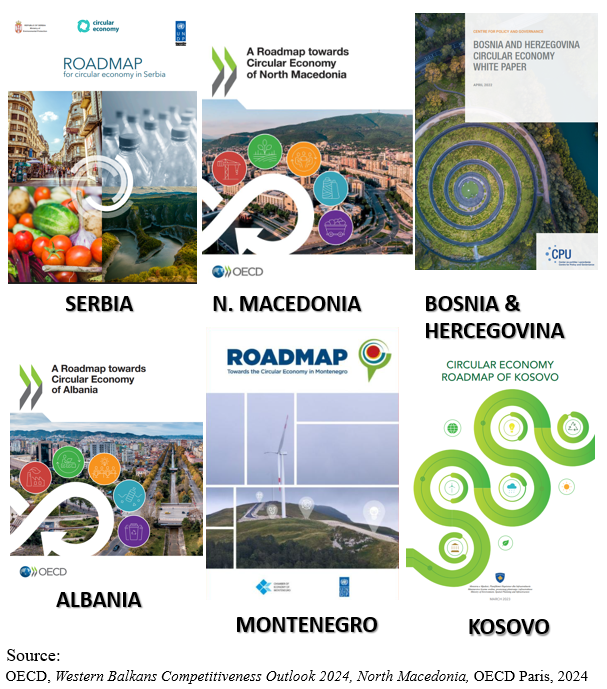
To fuel this transition, the European Commission’s Economic and Investment Plan (EIP) has mobilized billions of Euros in grants and in investments. Today, nearly every WB country has developed its own Circular Economy Roadmap.
Serbia led the charge, with the Chamber of Commerce and Industry of Serbia becoming the first regional institution to signal to the business community that future growth must be circular.
The Regional Cooperation Council (RCC) has further refined these goals through the Action Plan for 2025–2030.
The second pillar (CE) focuses on seven key actions, including Extended Producer Responsibility (EPR) to make WB manufacturers accountable for a product's entire lifecycle, waste management with focus on building modern infrastructure to replace outdated landfills, and combating plastic pollution, specifically targeting Single-Use Plastics (SUP) and marine litter.
Lack of Harmonized Data for Qualitative Research
Despite this progress, the region faces an implementation lag. Current research is heavily focuses on waste management rather than holistic circular design. There is a lack of harmonized data as well. Eurostat currently includes Western Balkan countries in very few circularity indicators, making it difficult to monitor progress effectively among these CEFTA countries and compare the results and progress with the EU. So, how can the EU measure progress in CE if the lack of harmonised data is evident?
Furthermore, the skills gap is widening. While the private sector is seeing the rise of initiatives like the Western Balkans Circular Economy Hub (WBCEH), which connects over 100 members to share best practices and boost circularity, academia has been slow to follow. We need more specialized Bachelor’s, Master’s and PhD programs to prepare the workforce for new green jobs.
The Pressure of Global Standards, like the Carbon Border Adjustment Mechanism (CBAM) and Corporate Sustainability Reporting Directive (CSRD) is already present. The urgency is being accelerated by EU regulations like the European Sustainability Reporting Standard (ESRS E5). WB companies exporting to the EU must now be able to report Scope 3 emissions and CE data to comply with the CSRD. This is becoming increasingly urgent as it can hinder exports towards EU, especially Germany. Large European companies must report on their circularity performance, so WB trading partners must provide the data and information about virgin vs. recycled materials which affects the entire value chain.
Import Dependence on Plastics, Mostly from EU
Currently, the region remains import-dependent regarding plastics and lacks mandatory household waste separation. The regions dependence on imported plastics is reflected in its trade with the EU, which accounts for 75,7% of the total imports of plastics into WB (Ivanova & Kikerkova, 2025). Furthermore, without digitalization and a shift in education, waste will remain waste instead of becoming a resource.
The Western Balkans is at a crossroads. We have the policy frameworks (Sofia Declaration) and the funding (EIP), but we lack data and specialized skills. And building those for system change needs time, vision, policy clarity, and smart specialization thinking. The world is only 6,9% circular (CGR, 2025), but awakeness in everyday actions across Europe, the Balkans, and the globe give us hope to keep pushing for circularity. The transition to a CE is the only way to ensure that our fertile ground remains productive for generations to come. We have to think about how to avoid the waste that we still do not know how to manage properly.
References
Circle Economy Foundation (2025) The Global Circularity Gap Report 2025. Amsterdam: Circle Economy. (avaliable at: https://www.circularity-gap.world/2025)
European Commission (2020) An Economic and Investment Plan for the Western Balkans. COM(2020) 641 final. Brussels: European Commission. (avaliable at: https://eur-lex.europa.eu/legal-content/EN/TXT/?uri=celex:52020DC0641)
Ivanova I., Kikerkova I., (2025), Exploring the dinamics of International Trade in Plastics between Western Balkans and the EU: A focus on circular economy practices, in KNOWLEDGE-International Journal Scientific Papers Vol.69, 1., IKM, Skopje,p.25 (avaliable at: https://ojs.ikm.mk/index.php/kij/article/view/7323)
OECD (2024) Western Balkans Competitiveness Outlook 2024. Paris: OECD Publishing. (avaliable at: https://www.oecd.org/en/publications/western-balkans-competitiveness-outlook-2024-regional-profile_170b0e53-en.html)
Regional Cooperation Council (2020) Sofia Declaration on the Green Agenda for the Western Balkans. Sarajevo: RCC. (avaliable at: https://www.rcc.int/docs/546/sofia-declaration-on-the-green-agenda-for-the-western-balkans-rn)
Regional Cooperation Council (2024) Balkan Barometer 2024: Public Opinion Survey. Sarajevo: RCC. (avaliable at: https://www.rcc.int/pubs/203/balkan-barometer-public-opinion-2024)
Regional Cooperation Council (2025) Revised Action Plan for the Implementation of the Sofia Declaration on the Green Agenda for the Western Balkans 2021-2030. Sarajevo: RCC. (avaliable at: https://www.rcc.int/pubs/217/revised-green-agenda-action-plan-20252030)
National Circular Economy Roadmaps
Albania: OECD (2024), A Roadmap towards Circular Economy of Albania, OECD Publishing, Paris, https://doi.org/10.1787/8c970fdc-en
Bosnia and Herzegovina: Abaspahic,H,Suljic,V. Garic,M and Krupic,S. (2022) Bosnia and Herzegovina Circular Economy White Paper.Sarajevo:Centre for Policy and Governance (CPU) (avaliable at: https://zelenaekonomija.komorabih.ba/wp-content/uploads/2023/10/White_Paper_Publication_28042022.pdf)
Kosovo: Government of the R.of Kosovo, Ministry of Environment, Spatial Planning and Infrastructure (UNDP Support) ,Circular Economy Roadmap of Kosovo (2023). (avaliable at: https://circulareconomy.europa.eu/platform/en/strategies/circular-economy-roadmap-kosovo)
Montenegro: Roadmap towards the Circular Economy in Montenegro (2022), (avaliable at: https://www.undp.org/montenegro/publications/roadmap-towards-circular-economy-montenegro)
North Macedonia: OECD (2024), A Roadmap towards Circular Economy of North Macedonia, OECD Publishing, Paris, https://doi.org/10.1787/1973c88c-en
Serbia: Ministry of Environmental Protection of the Republic of Serbia (2020), Roadmap for Circular Economy in Serbia. Belgrade. (avaliable at: https://www.undp.org/serbia/publications/roadmap-circular-economy-serbia)